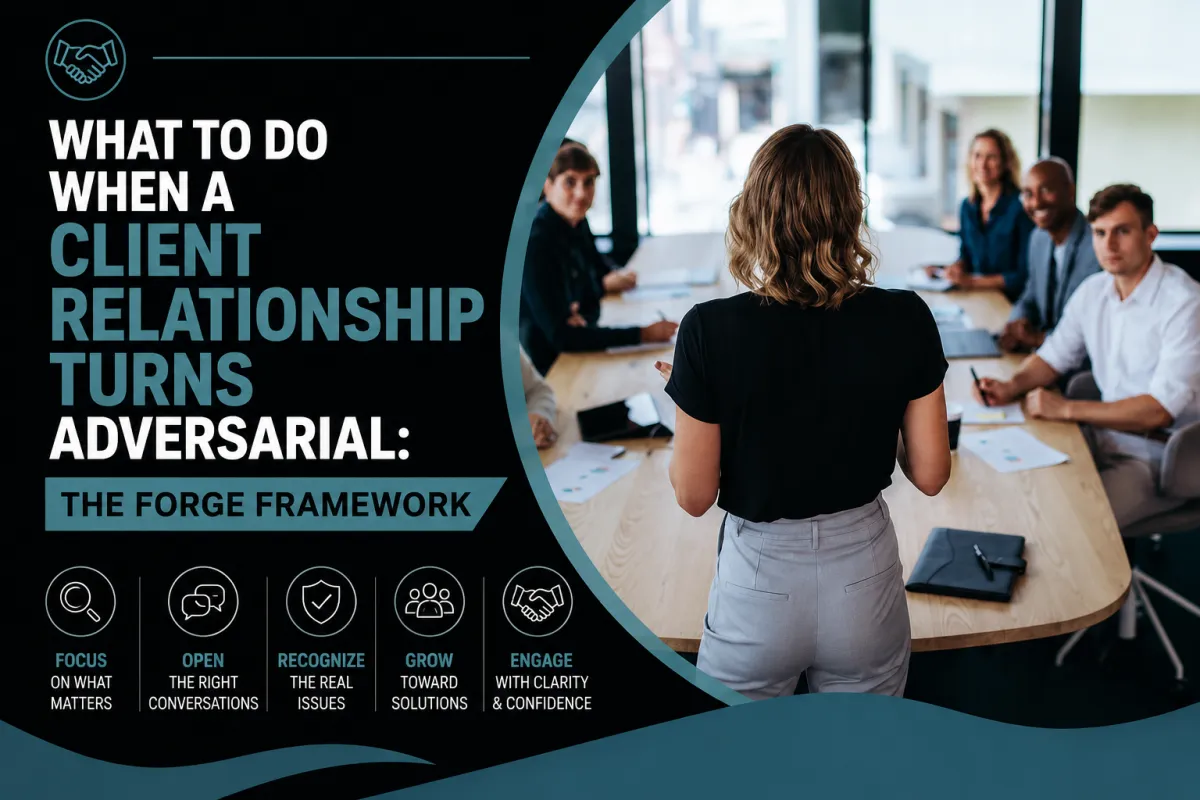
What to Do When a Client Relationship Turns Adversarial: The FORGE Framework

Learn to set firm boundaries with adversarial clients to protect your business and peace of mind.
The Unsettling Shift: When Collaboration Becomes Conflict
You’ve poured your expertise and passion into a client project, only to find the dynamic shifting. Their demands escalate, their tone becomes dismissive, and accusations begin to fly. The relationship feels adversarial, leaving you walking on eggshells, unsure how to regain control without jeopardizing the entire contract.
The High Cost of Unchecked Client Conflict
Allowing a client relationship to turn adversarial without intervention carries significant professional and personal costs. Professionally, it erodes your confidence, drains your team’s morale, and can lead to unchecked scope creep that impacts profitability. It can damage your reputation if word spreads that your boundaries are easily breached. Personally, the constant stress and anxiety can lead to burnout, resentment, and a diminished capacity to serve your other clients effectively. Your peace of mind and the health of your business are at stake.
The FORGE Framework Applied: Observing and Generating Solutions
When faced with an adversarial client, the FORGE Framework provides a structured path to re-establish control and healthy boundaries. For this scenario, we focus on Observe and Generate.
F — Focus: Define What You Actually Need From This Relationship
Before you respond to any specific incident, take a step back and focus on the bigger picture. Ask yourself one clarifying question:What does a healthy version of this client relationship look like — and is that still achievable?
This is not a passive question. It is a strategic one. Getting clear on your desired outcome — whether that is a renegotiated scope, a reset of communication norms, or a structured off-boarding — determines every move you make from here. Without this clarity, you will keep reacting to individual incidents rather than addressing the underlying dynamic.
"Focus is what separates a professional who manages a difficult client from one who is managed by them."
O — Observe: Document the Pattern, Not Just the Incident
Before you act, observe. What are the specific, factual behaviours that are problematic? Is the client consistently missing deadlines while demanding yours? Making unreasonable requests outside the agreed scope? Communicating disrespectfully in writing or in calls?
Separate the emotion from the action. Document instances, dates, and impacts. This is not about assigning blame — it is about gathering data so that when you have the conversation, you are speaking from evidence rather than frustration. A professional who says"I have noticed a pattern"and can name three specific examples is in a fundamentally different position than one who says"I feel like you are being unreasonable."
"I observe specific behaviours, not just feelings. That distinction is what gives me power in this conversation."
R — Reflect: Choose the Right Response for the Right Moment
Reflection is the step that keeps you from escalating a difficult situation into an irreparable one. Before you respond — whether in the moment or in a planned conversation — ask yourself: Is this the right time and setting to address this? What tone will keep the door open while still asserting my position? What outcome am I actually trying to achieve — a behaviour change, a contract amendment, or an exit?
Reflection also means being honest with yourself about whether this client relationship is salvageable. Sometimes the most strategic decision is to begin a structured off-boarding rather than continuing to pour resources into a dynamic that is fundamentally misaligned. That is not failure — it is leadership.
"Reflection is not hesitation. It is the moment you choose your response rather than letting the situation choose it for you."
G — Generate: Build Your Strategic Options
With your observations documented and your reflection complete, it is time to generate your response. This is where your Empowered Initiator steps forward to brainstorm multiple approaches to address the observed behaviours.
Your options might include: a direct, calm conversation that names the specific pattern and proposes a reset; a formal written communication that documents the scope and re-establishes the agreed terms; a contract amendment that reflects the actual scope of work; or a structured, professional off-boarding if the relationship is no longer viable.
Choose the option that upholds your boundaries and your values. Then build your language around it. A powerful opening for the direct conversation might be:"I want to talk about how we are working together, because I believe we can get this back on track — and I have some specific observations I would like to share."
"I generate solutions that honour my boundaries and my business. Both matter equally."
E — Engage: Have the Conversation You Have Been Avoiding
The final step is to engage — to actually have the conversation, send the communication, or initiate the renegotiation you have prepared for. This is the step most professionals delay the longest, and the delay always makes the situation worse.
Engagement does not have to be confrontational. It can be a calm, structured conversation that opens with curiosity and closes with clarity. It can be a written summary of the agreed scope sent after a difficult call. What it cannot be is silence — because silence in an adversarial dynamic is always read as permission.
When you engage from a place of preparation — with your observations documented, your options generated, and your desired outcome clear — you are no longer reacting. You are leading.
"Engagement is where your preparation becomes power. Everything before this step was getting ready. This is where the relationship either resets or ends — on your terms."
What Changes: From Chaos to Clarity
Applying Observe and Generate transforms a chaotic, adversarial client relationship into one of clarity and control. Before, you might have felt reactive, constantly trying to appease an insatiable client, leading to exhaustion and resentment. After, you become proactive, armed with data and a range of solutions.
Consider Sarah, a marketing consultant. Her client, initially enthusiastic, became increasingly demanding and dismissive of her team's expertise. Sarah felt her boundaries eroding. Using Observe, she documented every instance of scope creep and disrespectful communication. Then, in Generate, she brainstormed options: a firm conversation, a contract renegotiation, or a structured off-boarding. She chose a firm conversation, presenting her observations calmly and offering a revised project plan with clear boundaries. The client, confronted with facts, either respected the new terms or chose to conclude the engagement, allowing Sarah to regain her focus and protect her team.

The Longer Game: Cultivating Resilient Leadership
Mastering the art of navigating adversarial client relationships is more than just saving a single project; it's about cultivating resilient leadership. Each time you Observe objectively and Generate empowered solutions, you strengthen your capacity to lead with integrity and confidence. You build a business founded on mutual respect, attracting clients who value your expertise and honor your boundaries. This proactive approach to conflict transforms you into a leader who can navigate any challenge, fostering a thriving professional environment for yourself and your team.
Ready to Transform Your Conflict Approach?
Understanding your innate conflict style is the first step to transforming challenging professional dynamics. Discover your unique approach and unlock strategies for more effective communication and resolution. Take the free Conflict Style Quiz today and start your journey toward empowered leadership. CLICK HERE TO TAKE YOUR QUIZ!






Facebook
Instagram
LinkedIn