
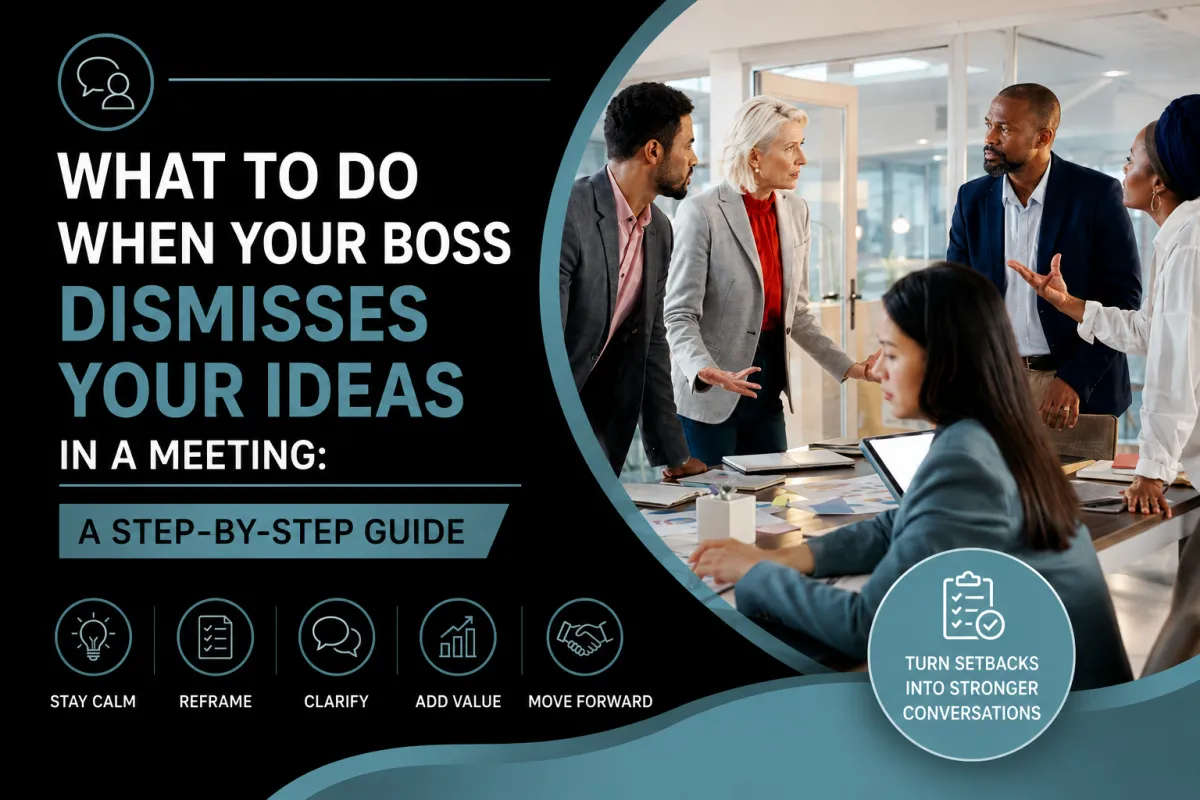
What to Do When Your Boss Dismisses Your Ideas in a Meeting: A Step-by-Step Guide

Being shut down in front of your colleagues is one of the most demoralizing moments in professional life, here is the exact strategy to respond with confidence, protect your credibility, and make sure it never defines you again
The meeting is in full swing. You have prepared. You have thought through the idea carefully. You take a breath and share it and your boss cuts you off, waves it away, or worse, redirects the conversation as if you never spoke. The room moves on. You sit there, face flushing, replaying the moment and wondering whether you should have stayed quiet.
If this has happened to you, you already know that the sting is not just about the idea being rejected. It is about being dismissed, in public, in front of peers, by someone with authority over your career. And the way you respond in the next sixty seconds, and in the days that follow, will determine whether this becomes a pattern that shrinks your professional presence or a turning point that expands it.
This is one of the most common and most damaging conflict scenarios in professional life. It is also one that the FORGE Framework, the methodology at the heart of the Conflict Code program was specifically designed to address.

Why Being Publicly Dismissed Feels So Paralyzing
The reason this scenario hits so hard is not weakness. It is neuroscience. When we experience a public social threat, being ignored, interrupted, or belittled in front of others, the brain processes it through the same threat-response circuitry as a physical danger. Your heart rate spikes. Your thinking narrows. The instinct to either fight back aggressively or go completely silent takes over.
Neither response serves you. Snapping back in the moment risks being labelled as defensive or difficult. Going silent reinforces the dynamic and signals to everyone in the room including yourself, that the dismissal was acceptable.
What you actually need in that moment is a third option: a strategic response that is calm, clear, and confident. That response does not come naturally under pressure. It has to be built in advance.
The FORGE Framework Applied: From Dismissed to Heard
Here is how the five steps of FORGE work in this specific scenario, in real time.
Step 1 — Focus: Interrupt the Freeze
The moment you feel dismissed, your first job is not to speak. It is to pause. Take one slow breath. Unclench your hands. This is the Focus step, the strategic interruption of your automatic threat response. It takes approximately three seconds, and it changes everything that comes after.
Most professionals skip this step because it feels passive. In reality, it is the most powerful thing you can do in that moment. You are choosing your response rather than being hijacked by your reaction.
Step 2 — Observe: Read the Room Before You Respond
Before you say a single word, spend five seconds observing. Is your boss distracted, under pressure, or genuinely dismissive? Is the room uncomfortable, are colleagues avoiding eye contact? Is this a pattern or an anomaly? The Observe step turns you from a participant in the conflict into a strategist above it.
What you observe will shape how you engage. A boss who is visibly stressed and moving fast through an agenda requires a different approach than one who has a habit of dismissing certain voices. Observation gives you the data you need to choose your next move wisely.
Step 3 — Reflect: Separate the Sting from the Strategy
Here is where most professionals get derailed. The internal narrative that kicks in — "They never take me seriously," "I am invisible here," "Why do I even bother" is not data. It is a story, and it is almost always an overstatement of what actually happened.
The Reflect step asks you to separate the factual event (your idea was not acknowledged in this meeting) from the emotional interpretation (you are undervalued and powerless). This distinction is not about minimizing what happened. It is about keeping your response proportionate, strategic, and effective.
Step 4 — Generate: Create Your Options
You have more options than you think. The Generate step asks you to identify at least three possible responses before choosing one. For example:
In the moment, you might choose to re-enter the conversation calmly: "I want to come back to the point I raised — I think it is directly relevant to what we are discussing." This is assertive without being aggressive, and it signals to the room that you are not going to be talked over.
After the meeting, you might request a one-on-one with your boss to share the idea in a lower-stakes context, framing it around the outcome they care about most. Or you might document the idea in writing and send it as a follow-up, creating a paper trail that demonstrates both the quality of your thinking and your professionalism.
Generating options prevents you from defaulting to the two extremes silence or outburst and gives you agency in a situation that felt like it took your agency away.
Step 5 — Engage: Re-enter with Purpose
The final step is choosing the best option and executing it with composure. Whether you re-enter the meeting conversation or follow up afterward, the Engage step is where your preparation pays off. You are not reacting. You are leading.
The power phrase that works consistently in this scenario is deceptively simple: "I want to make sure this idea gets a fair hearing, can we take two minutes to look at it together?" It is direct. It is non-confrontational. And it puts the responsibility for the conversation back where it belongs.

What Changes When You Use This Framework
The first time you apply FORGE to a dismissal scenario, the outcome may not be perfect. Your voice might shake slightly. The boss might still redirect. But something important will have shifted: you will have responded rather than retreated. And that shift from passive to strategic is visible to everyone in the room, including you.
By Month 1 of the Conflict Code program, most participants report completing their first difficult conversation using the full FORGE sequence and walking away feeling heard rather than defeated. By Month 3, the scenario that once caused a freeze response has become one they navigate with the same ease as any other professional skill.
The shift from dismissed to heard does not happen by accident — it happens by design. The Conflict Code program gives you the complete framework, the language, and the practice reps to make strategic responses your default — not your exception.
The Longer Game: Building a Reputation as Someone Who Cannot Be Dismissed
One well-handled dismissal does not just resolve a single moment. It begins to rewrite the professional narrative others hold about you and more importantly, the one you hold about yourself.
Professionals who learn to respond to dismissal with composure and clarity are consistently perceived as more senior, more credible, and more promotable than those who either fight back or go quiet. Your conflict style is, in many ways, your leadership brand. The question is whether you are building that brand intentionally or by default.
The Conflict Code program identifies three distinct conflict styles the Strategic Communicator, the Grounded Diplomat, and the Empowered Initiator and gives each one a specific roadmap for navigating dismissal, disagreement, and high-stakes conversations. Understanding which style you default to is the first step toward choosing which one you want to lead with.
Take the free Conflict Style Quiz to discover your default approach and gain some valuable insights into your specific professional challenges.






Facebook
Instagram
LinkedIn