
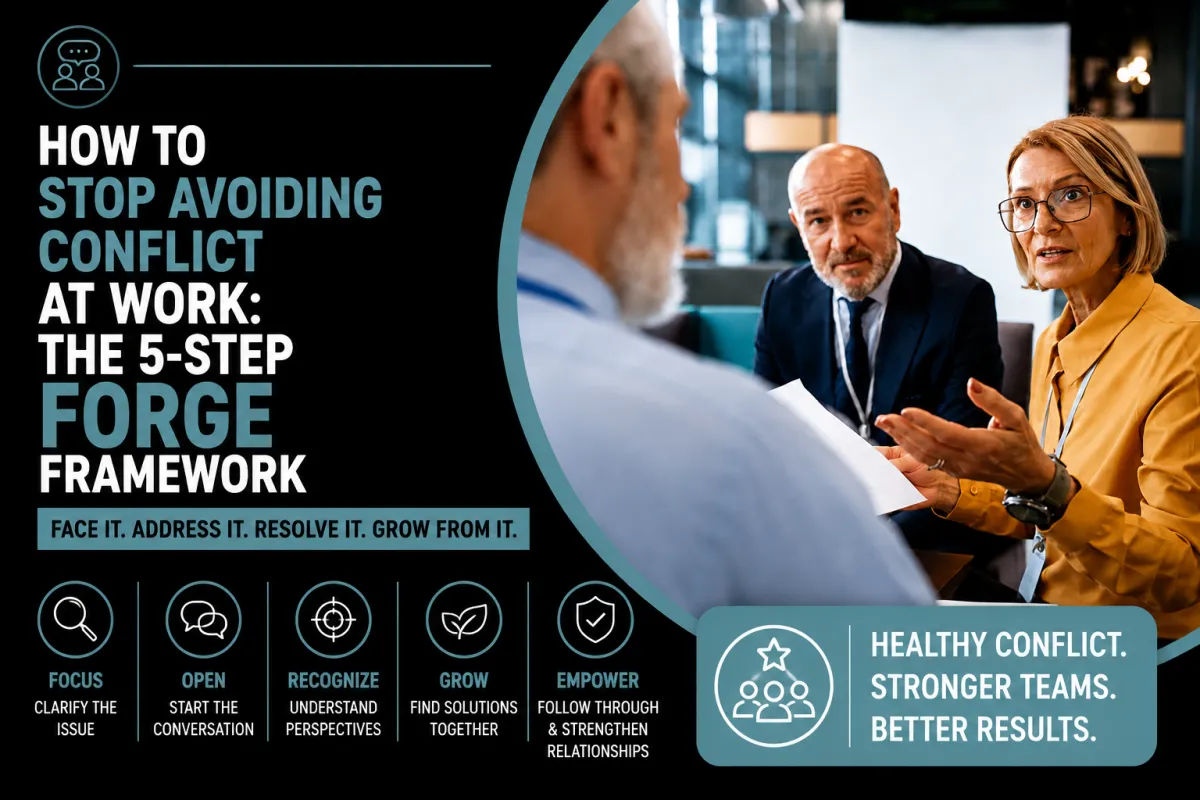
How to Stop Avoiding Conflict at Work: The 5-Step FORGE Framework

Conflict is an inevitable part of the professional world. Yet, for many leaders and professionals, the immediate instinct when faced with workplace tension is to step back. You might tell yourself you are "keeping the peace" or "taking the high road," but the reality is often much costlier.
Are you avoiding difficult conversations? If so, you are not alone, but that avoidance is likely impacting your team's trust, your personal stress levels, and your career trajectory. In fact, sidestepping crucial conversations allows minor issues to fester into major roadblocks, eroding team cohesion and limiting your professional advancement.
The good news? Conflict does not have to mean combat. By mastering the art of productive discomfort, you can transform workplace friction from a source of anxiety into a powerful catalyst for collaboration. Here is how to stop avoiding conflict and start leading through it using a proven methodology: the FORGE Framework.

The Hidden Costs of Conflict Avoidance
Before learning how to address conflict, it is essential to understand why avoiding it is so damaging. When you put off a tough talk, you pay a steep price in several areas:
Trust Erodes: Unspoken issues fester, and colleagues begin to question transparency and reliability.
Stress and Anxiety Multiply: The constant dread of a potential confrontation impacts your daily well-being and productivity.
Career Growth Stalls: The inability to effectively advocate for your ideas or yourself limits your professional influence and advancement.
Relationships Suffer: When tension finally boils over, reacting emotionally instead of responding strategically damages professional relationships.
The goal is not to become aggressive, but to become a strategic communicator who can handle any situation with poise.
Enter the FORGE Framework: Your Map for Difficult Conversations
To move from a reactive or avoidant posture to one of confident leadership, you need a repeatable system. The Conflict Code program introduces the FORGE Framework, a five-step mental map designed to help you navigate conflict in the moment.
Here is how the FORGE method works to de-escalate tension and build consensus:
1. Focus: The Strategic Pause
The first step is regulating your physiological response. In the heat of the moment, our brains often default to fight-or-flight mode. Instead of reacting instantly, take a strategic pause. Breathe and ground yourself. This single micro-pause prevents you from saying something you will later regret and allows your logical brain to catch up.
2. Observe: Gather the Data
Next, become a data-gatherer. Look beyond the immediate words being spoken. What is the other person's body language communicating? What is the unspoken underlying need? By observing the emotional landscape and the facts of the situation, you begin to see the full picture rather than just the surface argument.
3. Reflect: Separate Fact from Story
We often escalate conflicts based on the stories we tell ourselves about another person's intent. In this step, you must process your observations objectively. Ask yourself: What do I know for certain, and what am I assuming? Separating the factual events from your emotional narrative is where you regain control of the situation.
4. Generate: Brainstorm Options
Avoidant communicators often feel trapped because they only see two options: fight or flee. The "Generate" step forces you to brainstorm at least three possible responses or outcomes. Instead of being locked into a single reaction, you create strategic options for yourself. Strategy beats reaction every time.
5. Engage: Execute with Empathy
Finally, you choose the best option and step into the conversation with purpose. Communicate assertively and respectfully, aiming to build the relationship rather than "win" the argument. Lead with shared goals, use "I" statements, and end with a clear, collaborative next step.

Real-World Application: Moving from Blame to Problem-Solving
Consider the scenario of a project manager who historically avoided confrontation. When a senior stakeholder publicly blamed her team for a project delay, her old pattern would have been to freeze or silently accept the blame to keep the peace.
By applying the FORGE framework, she changed the dynamic entirely. She Focused by taking a deep breath instead of getting defensive. She Observed the stakeholder's anxiety about the deadline. She Reflected on the factual project timeline. She Generated a response that was firm yet collaborative. Finally, she Engaged by stating:
"I understand the pressure we're all under. Let's look at the project timeline together to identify the initial bottleneck and find a solution."
The conversation shifted instantly from blame to problem-solving. She protected her team and earned a new level of respect from leadership.
Take the Next Step in Your Leadership Journey
Mastering conflict is about aligning your self-image with your desired leadership style. It is about building "firewalls" that prevent conflict from escalating and learning the strategic power phrases that give you clarity in tense moments.
Ready to discover your default approach to workplace friction? Take the free "What's Your Conflict Style?" Quiz today to uncover your unique strengths and growth edges.
By understanding your baseline, you can begin applying the FORGE Framework to master the art of productive discomfort and elevate your career.





Facebook
Instagram
LinkedIn